In this guide, we break down what each drain cleaning method actually costs, what every line item on a real plumbing invoice should look like, and how prices shift across Arizona, California, Colorado, and Florida, the four states Elite Rooter serves. If you are searching for a drain service near me or comparing quotes from multiple plumbers, this page gives you the numbers you need to make an informed decision.
What Are the Different Drain Cleaning Methods and How Do They Work?
Drain cleaning is not one technique it is a toolkit. The right method depends on what is clogging the pipe, where the clog sits, what the pipe is made of, and how old it is.
Here are the main techniques a professional plumber uses, and how each one actually works:
1. Drain Snaking (Cable Auger)
A drain snake also called a cable, auger, or rooter is a flexible metal cable with a corkscrew, hook, or cutting tip on the end. The plumber feeds the cable into the drain, cranks it forward until it hits the blockage, then rotates the head by hand or with a drill attachment. The tip either grabs the clog so it can be pulled out, breaks through it, or chews it apart.
Hand snakes typically reach 25 feet and handle bathroom sinks, tubs, and toilet clogs. Closet augers are a shorter version designed to navigate the curved trap inside a toilet without scratching the porcelain. The cost to snake a drain is the lowest of all professional methods, making it the go-to option for most household clogs.
2. Motorized Drum Machine
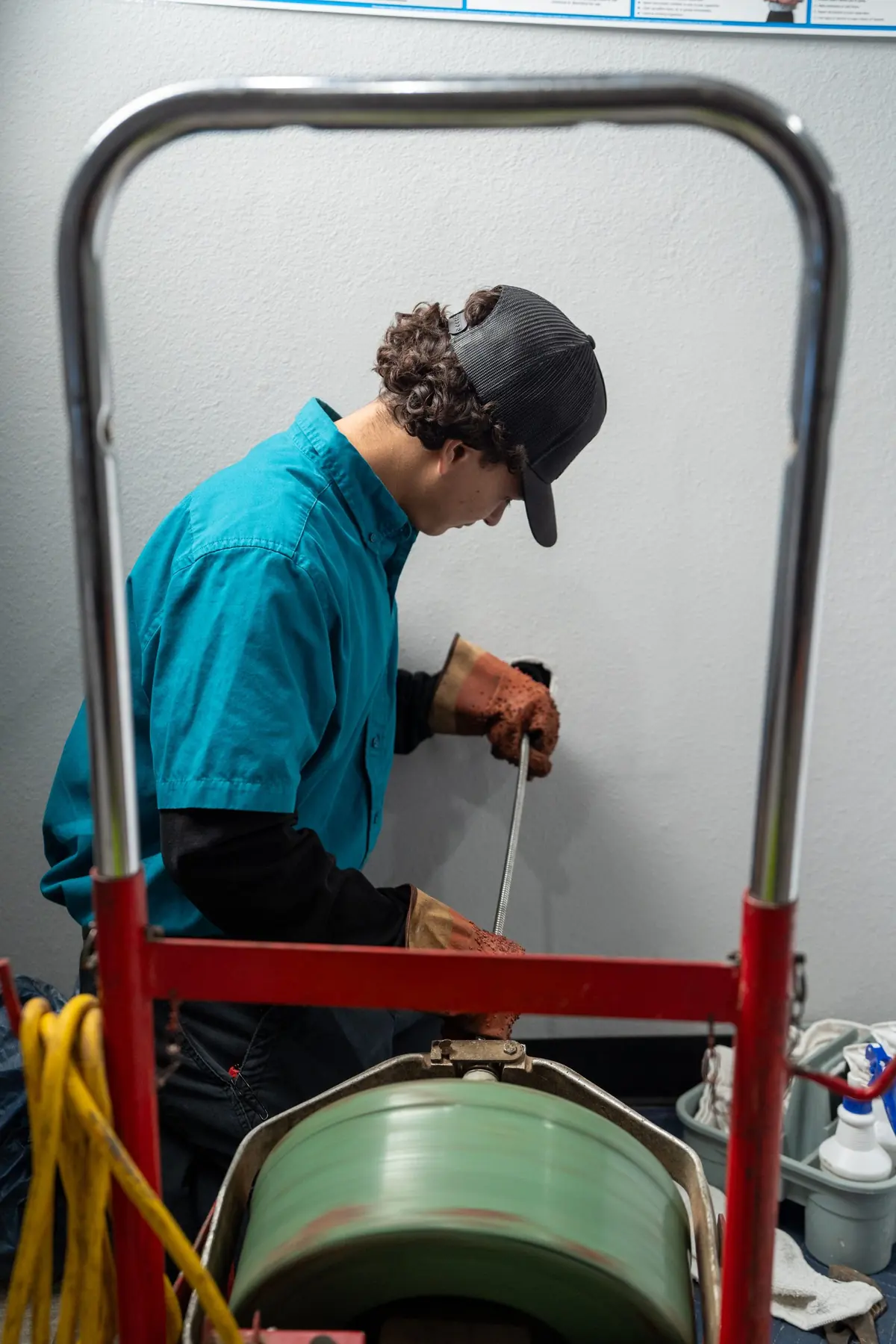
For branch drains and main sewer lines, plumbers move up to a powered drum machine essentially a much bigger snake driven by an electric motor. The cable is thicker (3/8″ to 5/8″ or more) and reaches 50 to 100 feet. Interchangeable cutter heads at the end do different jobs: a spear tip punches through soft blockages, a saw-blade head chews through grease, and a root cutter slices through tree roots that have grown into the pipe.
The plumber feeds the spinning cable through a cleanout access and works it down the line until flow returns. Main drain cleaning with a drum machine is the standard approach for sewer line blockages that a hand snake cannot reach.
3. Hydro Jetting
Hydro jetting is the heavy-duty option. A specialized hose with a multi-directional nozzle is fed into the drain, then connected to a machine that pumps water through it at 1,500 to 4,000 PSI. The forward-facing jet blasts through the clog while rearward-facing jets propel the hose down the pipe and scour the pipe walls clean as they go.
Unlike snaking, which only punches a hole through the blockage, hydro jetting strips off the grease, scale, and debris coating the entire pipe interior. It is the only method that fully cleans the line but it requires a camera inspection first, because that kind of pressure can finish off a pipe that is already cracked or deteriorated.
4. Pipe Descaling (Chain Knocker)
Older homes with cast iron pipes often have mineral scale and corrosion buildup that snaking cannot remove and hydro jetting alone will not fully reach. A chain knocker a flexible shaft with small spinning chains or carbide tips on the end is fed into the pipe and rotated at high speed, mechanically knocking the scale off the interior walls. It is typically followed by hydro jetting to flush the debris out.
5. Chemical Drain Cleaners
Hardware-store chemical cleaners fall into four categories. Caustic cleaners (sodium hydroxide / lye) generate heat and saponify grease. Acidic cleaners (sulfuric or hydrochloric acid) dissolve organic matter aggressively. Oxidizing cleaners (bleach and peroxide-based) chemically break down material. Enzymatic cleaners use live bacteria to slowly digest organic buildup the safest option for pipes, but slow-acting.
None of these clean pipe walls the way mechanical methods do; they only attack the clog itself, and the caustic and acidic versions damage pipes with repeated use. The EPA's Safer Choice program recommends checking product labels for safer alternatives when dealing with household drain issues.
How Much Does It Cost to Snake a Drain in 2026?
Snaking is the most affordable professional drain cleaning method, and for most household clogs, it is all you need. Expect to pay $100 to $275 for snaking a toilet, sink, tub, shower, or laundry drain fixture-level jobs that usually take a plumber 30 to 60 minutes from arrival to flow restored. Main line snaking runs $150 to $500, since the cable has to travel 50 to 150 feet, the equipment is heavier, and the job takes longer to set up.
The cost to snake a drain drops on the low end when there is an accessible cleanout, and climbs fast when the plumber has to pull a toilet to reach the line. National franchise drain service companies typically charge $225 to $500 for the same work one reason independent, locally-licensed plumbers often deliver better value without cutting corners on quality.
Hydro Jetting Cost in 2026: When the Extra $400 Pays for Itself
Hydro jetting costs more upfront than snaking, but for the right clog, it is the cheaper choice over a 12-month window. Most homeowners pay $350 to $800 for residential hydro jetting in 2026, with main sewer line work running $600 to $1,500 depending on access, line length, and clog severity. Kitchen and bathroom drains fall on the lower end ($250 to $500); commercial jobs and restaurant grease lines push higher.
The price gap from snaking is real, but so is what you are buying. A snake punches a hole through the clog. Hydro jetting strips the pipe walls clean, blasting grease, scale, sludge, and tree roots out at 1,500 to 4,000 PSI until the line flows like new. The result lasts noticeably longer.
Snaking 3× a Year vs. One Jetting Visit
If you are calling a plumber to snake the same drain every few months, the math flips fast. Three snaking visits at $200 each runs $600, and you still have a coated, narrowing pipe that is going to clog again. One hydro jetting service at $500 to $800 cleans the line down to bare pipe and typically keeps it clear for two to three years. Over a 24-month window, that is $400 to $1,200 in repeat snaking calls avoided.
The math only works one way, though: hydro jetting needs healthy pipes. Older cast iron, clay, or cracked PVC cannot always handle the pressure, which is why a reputable plumber runs a camera inspection first. If your pipes pass the inspection and you have snaked the same drain more than twice in the last year, hydro jetting almost always pays for itself.
Chemical Drain Cleaner Cost: Including the Hidden Pipe-Damage Bill
A bottle of chemical drain cleaner costs $5 to $30 at any hardware store. That is the sticker price. The real price shows up months or years later, and it is the part nobody on the bottle's label is going to tell you about.
Chemical drain cleaners fall into three categories, and each one attacks your pipes differently. Caustic cleaners (sodium hydroxide, also known as lye) generate intense heat as they react with grease heat that can soften and warp PVC at the joints. Acidic cleaners (sulfuric or hydrochloric acid) are the strongest and most damaging; they corrode metal pipes, especially older galvanized steel and copper. Oxidizing cleaners (bleach and peroxide-based) are gentler but still degrade rubber seals and pipe joints with repeated use.
The chemistry does not stop at the clog. The reaction continues until the product fully drains out, and any chemical that pools at a bend, joint, or weak spot keeps eating away at that exact location.
When a $12 Bottle Is Defensible
One-time use on a healthy PVC drain to break up a hair clog or light soap scum? Probably fine. The damage is cumulative, not catastrophic. Most pipes can tolerate occasional use without measurable harm.
When That $12 Bottle Becomes a $500–$3,000 Bill
The trouble starts the second time. If the first bottle did not fully clear the drain and it usually does not, because chemical cleaners burn a narrow channel through the clog rather than removing it the cycle begins. You pour a second bottle. The clog returns in two weeks. You pour a third. Each application stresses the pipe a little more, and now you have caustic chemicals trapped behind a partial clog, sitting against pipe walls for hours.
The repair bills that follow look like this: pipe section replacement runs $300 to $1,500 for a single damaged segment. A cracked toilet from heat-induced stress costs $200 to $600 to replace. Full re-piping of a kitchen or bathroom branch line lands at $1,500 to $3,000. And if the cleaner damages a section of main sewer line, you are looking at $50 to $250 per linear foot for replacement.
What Plumbers Use Instead
The two safer chemical alternatives are enzyme-based cleaners ($15–$25), which use live bacteria to slowly digest organic buildup without harming pipes, and a homemade flush of baking soda followed by white vinegar, which handles light buildup and odor for under $5. Neither will clear a real clog, but both are safe for routine maintenance and will not void your plumbing warranty.
The honest rule of thumb: if one application of chemical cleaner does not solve the problem, the answer is not a second bottle. It is a $150 drain service call that actually removes the clog instead of burning a hole through it.
Why Professional Drain Cleaning Costs What It Does
A $200 drain cleaning bill might feel steep until you understand what is behind it. A properly equipped drain cleaning truck carries $80,000 to $150,000 in equipment: a sewer camera system ($8,000–$15,000), multiple auger machines ($2,000–$5,000 each), a hydro jetter ($5,000–$20,000+), a utility locator, and a vehicle built to haul it all. Every piece of that equipment has to be maintained, calibrated, insured, and eventually replaced.
On top of that, every technician on the truck holds a state-specific plumbing license. Florida requires a CFC certification through the Florida Department of Business & Professional Regulation. Arizona requires an ROC C-37 license verified through the Arizona Registrar of Contractors. California requires a C-36 license tracked by the Contractors State License Board. Colorado licensing varies by municipality and is overseen by the Colorado Department of Regulatory Agencies. Licensing, insurance, bonding, continuing education, and workers' comp all factor into the rate you see on the invoice.
When a plumber quotes $200 for a drain cleaning, you are not paying for 45 minutes of labor. You are paying for a licensed professional with the right equipment, the right training, and the liability coverage to stand behind the work if something goes wrong.
What Drain Cleaning Costs in Your Market: AZ, CA, CO & FL
National averages tell you what drain cleaning costs somewhere. They do not tell you what it costs where you live and that gap matters, because a $243 national average hides 30% to 40% swings in either direction depending on local labor rates, pipe age, water chemistry, and whether tree roots are hunting your sewer line. Here is what the numbers actually look like in the markets we serve.
Phoenix, AZ: Hard Water Meets 1970s Cast Iron
Phoenix homes built between 1960 and 1985 typically run cast iron drain lines, and the Valley's notoriously hard water (12–17 grains per gallon in most ZIP codes) has been depositing mineral scale inside those pipes for fifty years. Standard kitchen and bathroom snaking runs $180 to $350. Main line snaking lands at $250 to $500, and hydro jetting on a residential main runs $450 to $950 depending on access and line length. Older properties often need pipe descaling before jetting can do its job adding $200 to $400 to the bill, but extending pipe life by years.
If you need drain cleaning in Phoenix, expect pricing on the higher end of the national range due to the equipment-intensive nature of descaling jobs.
Tucson, AZ: Similar Pricing, Different Pipe Profile
Tucson pricing tracks closely with Phoenix $180 to $350 for fixture snaking, $450 to $950 for main-line jetting but the underlying pipe profile shifts. More homes here have clay or Orangeburg sewer laterals from the postwar boom, both of which crack under root pressure and do not tolerate high-PSI jetting without a camera inspection first. Expect a $150 to $300 camera inspection on most main-line jobs in Tucson, and consider it money well spent.
For drain cleaning in Tucson, always ask your plumber about pre-jetting camera inspection it can prevent a $500 cleaning from turning into a $5,000 pipe replacement.
Tampa, FL: Where Tree Roots Drive the Pricing
Tampa's combination of mature live oaks, sandy soil, and high water tables creates one of the most aggressive root intrusion problems in the country. Roots find micro-cracks in clay and cast iron lines and grow into the pipe at full force. Standard snaking starts at $180 to $350, but root-cutting service runs $300 to $600, and hydro jetting with root removal lands at $500 to $1,100. Florida's humidity also accelerates corrosion in older galvanized supply lines that share crawl spaces with drain lines, so a camera inspection here often catches secondary problems worth knowing about.
For drain cleaning in Tampa, root-related clogs are the number one driver of higher-than-average bills.
Ventura, CA: Coastal Permits and Higher Labor Rates
California has the highest plumbing labor rates of the four states we serve, and Ventura County permit requirements add complexity to anything touching the main sewer line. Fixture snaking runs $200 to $400, main-line snaking lands at $300 to $550, and hydro jetting starts at $500 and can reach $1,200 on longer or harder-to-access lines. Coastal salt air also accelerates corrosion on metal cleanout caps and access fittings, which is why drain cleaning in Ventura jobs occasionally include $50 to $150 in fitting replacement that homeowners do not expect.
San Jose, CA: Bay Area Rates with Aging Infrastructure
San Jose sits in one of the highest cost-of-living metros in the country, and drain cleaning prices reflect that. Fixture snaking runs $220 to $420, main-line snaking lands at $350 to $600, and hydro jetting ranges from $550 to $1,300. Many homes in older San Jose neighborhoods (Willow Glen, Rose Garden, Japantown) have original cast iron lines from the 1940s–1960s that are approaching or past their useful life.
Camera inspections before jetting are not optional in these homes they are essential. For drain cleaning in San Jose, budget for the inspection as part of any main-line service.
San Diego, CA Year-Round Demand Keeps Pricing Steady
San Diego's mild climate means drain cleaning demand does not spike seasonally the way it does in freeze/thaw or hurricane markets but it also means plumbers stay busy year-round, keeping rates firm. Fixture snaking runs $200 to $400, main-line work lands at $300 to $550, and hydro jetting ranges from $500 to $1,200. Hard water from the Colorado River Aqueduct (15–22 gpg in many areas) accelerates scale buildup, making jetting a better long-term value than snaking for repeat clogs.
For drain cleaning in San Diego, hard-water scale is the hidden cost driver that most homeowners do not realize until their third snaking call in 18 months.
Denver & Colorado Springs, CO Freeze/Thaw and Mountain Hard Water
Colorado's freeze/thaw cycles put unique stress on drain lines pipes that were fine in October can develop cracks by March. Denver and Colorado Springs fixture snaking runs $175 to $340, main-line snaking lands at $250 to $500, and hydro jetting ranges from $450 to $950. Colorado's mountain-source hard water (8–14 gpg depending on the utility district) contributes to mineral buildup, and older Denver neighborhoods (Capitol Hill, Highlands, Park Hill) have some of the most deteriorated cast iron drain systems in the state.
For drain cleaning in Denver or drain cleaning in Colorado Springs, schedule your annual cleaning in late spring before the summer storm season puts extra pressure on already-stressed pipes.
Data Point for Reference: Across Elite Rooter's service areas, standard kitchen-sink drain cleaning runs $180–$350; main-line jetting runs $450–$950 depending on access and length. Prices have risen 25–40% since 2022 across all major U.S. metros due to increased labor costs, equipment prices, and insurance premiums.
How Often Should You Schedule Professional Drain Cleaning?
Most plumbers agree on a baseline: once a year for the average household. Annual professional cleaning catches grease, soap scum, and mineral buildup before it turns into a clog, and it is the single cheapest form of plumbing insurance you can buy. A $200 maintenance visit is a lot easier to swallow than a $1,500 emergency main-line backup at 11 p.m. on a Sunday.
That said, "once a year" is a starting point, not a rule. Your actual schedule depends on three things: how old your home is, what is growing around it, and how hard your household uses the drains.
Annual Maintenance for Most Homes
A two-to-four-person household in a home built after 1990, with PVC drain lines and no mature trees within 30 feet of the sewer lateral, can usually run on a once-a-year schedule and never see a major clog. Annual service typically means a snaking pass on the kitchen and main line, plus a camera check every two to three years to confirm nothing is developing underground.
Every 18 to 24 Months for High-Use Households
Larger families, frequent home cooking, long-haired residents, and homes with pets that shed heavily put more stress on drain lines. Plan on professional cleaning every 18 to 24 months, with extra attention to the kitchen line grease is the number-one cause of recurring kitchen clogs, and it builds faster than most homeowners realize.
Every 12 Months or Less for Older Homes and Mature Trees
Homes built before 1980 with cast iron, clay, or galvanized drain lines need more frequent service every 6 to 12 months is realistic, especially if you have trees within 20 feet of the sewer lateral. Roots find micro-cracks in older pipe joints and grow toward the moisture inside. Annual root-cutting service is far cheaper than letting a root mass collapse a section of line, which can run $50 to $250 per linear foot to replace.
Quarterly to Monthly for Restaurants and Commercial Properties
Restaurants, food service kitchens, hotels, and apartment buildings with shared drain stacks need professional cleaning every 1 to 3 months. Grease trap maintenance is mandatory in most jurisdictions, and high-volume kitchens can build a clog-causing layer of fat in a matter of weeks. Most commercial properties run on a maintenance contract for exactly this reason it is predictable, it is tax-deductible as a business expense, and it prevents the kind of failure that shuts down service.
Frequently Asked Questions About Drain Cleaning Cost
How much does drain cleaning cost in 2026?
Most homeowners pay $100 to $800 for professional drain cleaning in 2026, with a national average around $243. Simple fixture clogs (sink, tub, toilet) run $100 to $275. Main line snaking costs $150 to $500. Hydro jetting runs $250 to $1,500 depending on access, line length, and severity. Your actual drain cleaning cost depends on your location, the method used, and how difficult the clog is to access.
Is hydro jetting more expensive than snaking?
Yes, hydro jetting typically costs $350 to $800 for residential work, compared to $100 to $275 for snaking. However, jetting cleans the entire pipe interior (the entire pipe interior rather than a hole through the clog), so it lasts 2 to 3 years versus snaking's 3 to 6 months on chronic clogs. For repeat clogs, hydro jetting is often cheaper over a 12-month window.
Does homeowners insurance cover drain cleaning?
Standard homeowners insurance typically does not cover routine drain cleaning or clogs caused by normal wear. However, if a sudden sewer backup causes water damage to your home, the damage itself may be partially covered under some policies. Check your policy for "sewer backup" or "water backup" endorsements these are usually optional add-ons that cost $40 to $100 per year.
What is the cheapest way to unclog a drain?
A plunger is the cheapest option ($5 to $15) and works for minor toilet and sink clogs near the drain opening. For deeper clogs, a hand snake ($15 to $30 to buy) can reach 15 to 25 feet. If neither works, professional snaking ($100 to $275) is the most cost-effective professional method. Avoid chemical cleaners for recurring clogs the cumulative pipe damage costs far more than a single drain service call.
When does drain cleaning become a repair job?
Drain cleaning becomes a repair when the camera inspection reveals cracked, collapsed, separated, or corroded pipe. If the clog keeps returning every few weeks despite proper cleaning, the pipe itself is likely the problem a belly (sag), root intrusion through a broken joint, or a collapsed section. At that point, you need pipe repair ($300 to $3,000) or sewer line replacement ($50 to $250 per linear foot).
How long does professional drain cleaning take?
Most fixture-level drain cleaning (sink, tub, toilet) takes 30 to 60 minutes from arrival to flow restored. Main line snaking takes 1 to 2 hours. Hydro jetting with a camera inspection runs 2 to 3 hours. Complex jobs involving root removal, descaling, or difficult access can take half a day.
Can chemical drain cleaners damage pipes?
Yes. Caustic cleaners (lye-based) generate heat that can warp PVC joints. Acidic cleaners (sulfuric acid) corrode metal pipes, especially galvanized steel and copper. The damage is cumulative each application weakens the pipe further. Enzymatic (bacteria-based) cleaners are the only chemical option that will not harm pipes, but they work slowly and cannot clear real blockages.
How do I know if I need drain cleaning or sewer line repair?
If one drain is slow, it is usually a localized clog that cleaning will fix. If multiple drains back up simultaneously, water appears in floor drains, or you hear gurgling from fixtures when flushing a toilet, the problem is likely in the main sewer line. A camera inspection ($150 to $300) is the definitive way to determine if you are cleaning or repair.
What should I look for in a drain cleaning quote?
A transparent quote should include: the method (snaking vs. jetting), whether a camera inspection is included, the flat rate or hourly structure, any additional fees for access (pulling a toilet, opening a cleanout), and a written warranty. Be cautious of bait-pricing $49 drain cleaning offers that turn into $800 invoices once the plumber is on-site.
How much does emergency drain cleaning cost after hours?
Emergency and after-hours drain cleaning typically costs 1.5× to 2× the standard rate. If standard snaking runs $200 during business hours, expect $300 to $400 for the same job at 2 a.m. on a weekend. Some companies charge a flat after-hours dispatch fee ($75 to $150) on top of the service rate. Always confirm emergency pricing before booking.
Is annual drain cleaning really necessary?
For most homes, yes. Annual cleaning removes grease, soap, and mineral buildup before it becomes a full blockage. It is especially important in homes with cast iron or clay pipes, hard water, mature trees near the sewer line, or a history of recurring clogs. A $200 annual cleaning is significantly cheaper than a $1,500 emergency backup.
What is the difference between drain cleaning and sewer cleaning?
Drain cleaning refers to clearing individual fixture drains inside the home kitchen sinks, toilets, showers, tubs, and laundry drains. Sewer cleaning (or main line cleaning) addresses the larger pipe that carries wastewater from all fixtures to the municipal sewer or septic system. Sewer cleaning requires heavier equipment and typically costs more ($200 to $800 vs. $100 to $275 for fixture drains).
Get a Transparent Drain Cleaning Quote in Your Area
The hard part is not knowing the numbers it is finding a plumber who will quote you those numbers honestly the first time, without bait pricing, surprise add-ons, or the upsell to a $1,200 hydro jet when a $250 snake is all your drain actually needs.
Elite Rooter has been clearing drains across Arizona, California, Colorado, and Florida for years, and our pricing model is the same in every market: a flat diagnostic fee that is credited toward your service, a written estimate before any work begins, and honest method recommendations based on what your pipes actually need, not what pads the ticket. If snaking will solve it, we snake. If hydro jetting is the right call, we tell you why and show you the camera footage that proves it. If your pipe condition rules out high-pressure cleaning, we will tell you that too, and walk you through the safer options.
Every Elite Rooter technician is licensed, insured, and bonded in the state where they work. Every job comes with a workmanship warranty in writing. Every truck rolls equipped for the full range of techniques, so we can match the method to the clog instead of forcing the clog to match whatever is on the truck.
Call Your Local Elite Rooter for a Free Drain Cleaning Estimate:
- Phoenix, AZ: 866-805-5325
- Tucson, AZ: 866-805-5325
- Tampa, FL: 866-805-5325
- Ventura, CA: 866-805-5325
- San Jose, CA: 866-805-5325
- San Diego, CA: 866-805-5325
- Denver, CO: 866-805-5325
- Colorado Springs, CO: 866-805-5325
Our phones are answered 24/7 across all service areas, while emergency work is scheduled during posted business hours. Pricing is confirmed before you book, with no mystery surcharges.