
Tucson has some of the hardest water in the country, and summer makes it worse. The minerals that leave that crusty film never went anywhere, but the higher water use in June pushes more of them through your system than your softener can handle. A softener that worked fine all winter can quietly fail right when the heat hits.
The Short Answer: How Hard Tucson Water Is and Why Summer Makes It Worse
Tucson water runs hard, generally 12 to 22 grains per gallon depending on your part of town, with Central Arizona Project areas at the high end. Anything above 7 grains per gallon counts as hard, so Tucson sits at 2 to 3 times that threshold. Softeners fail in June because summer water use from irrigation, evaporative coolers, and extra showers pushes far more water through the system than winter does. An aging or undersized softener runs out of capacity between regenerations and lets hard water slip through right when demand peaks.
Why Water Softeners Fail in June
A water softener doesn't usually fail all at once. It fades. The system slowly loses capacity as the resin wears out, and for most of the year you never notice because winter water use is low. Then summer arrives and your household water demand can double. That sudden jump exposes a softener that was already running on borrowed time, which is why so many Tucson homeowners discover the problem in June.
Here's what summer does to a softener that winter hides:
Summer demand overwhelms an undersized softener
A softener has a fixed grain capacity between regenerations. In winter, a typical Tucson home might use 200 gallons a day, well within what the system handles. In summer, irrigation, evaporative coolers, pool topping, and longer showers can push that to 400 or 500 gallons a day. A softener built for a smaller household runs out of soft water capacity before its next regeneration and lets hard water through. You feel it as scale and weak lather returning.
Why aging resin gives out when you need it most
The resin beads inside a softener are what actually pull the hardness minerals out of your water. They wear out over 10 to 15 years, losing capacity a little each year. Tucson's high hardness wears resin faster than soft-water regions. An old resin bed might still handle winter demand but collapse under summer load, which is why a softener that limped through last year often fails completely the following June.
Tucson vs Phoenix: Why CAP Water Is Harder Than SRP
People assume all Arizona water is the same. It isn't. Tucson and Phoenix pull from different sources, and that difference is why Tucson water tends to run harder. Understanding where your water comes from explains why your softener works harder here than the same system would in Phoenix.
Here's the source difference that drives Tucson's hardness:
What the Central Arizona Project does to your water
Tucson blends local groundwater with Colorado River water delivered through the Central Arizona Project, known as CAP. Colorado River water carries a high mineral load picked up over hundreds of miles of riverbed and reservoirs. Phoenix uses a different source mix that includes Salt and Verde river water, CAP water, and groundwater. According to USGS water hardness data, the mineral content in a water supply depends heavily on the geology its source passes through, and the CAP route loads up the Colorado River source before it reaches your tap.
Why your Tucson zip code changes your hardness
Tucson doesn't deliver the same water everywhere. Some areas get mostly groundwater, some get mostly CAP water, and many get a seasonal blend. That's why one neighbor reports 12 grains per gallon and another across town reports 20. Check your address on the Tucson Water quality report to see your specific hardness before you size a softener.
The 5-Year Hard Water Damage Timeline
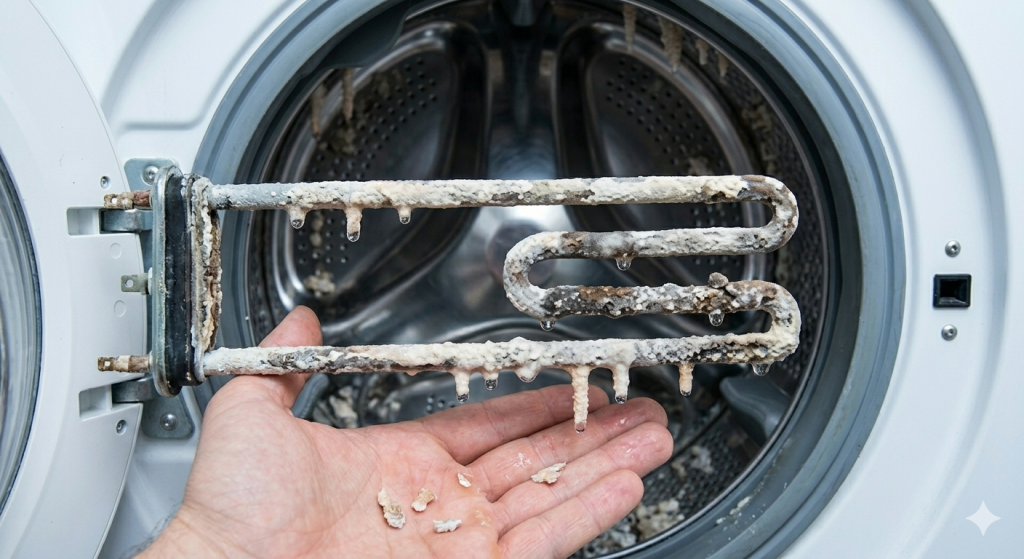
Hard water doesn't ruin your plumbing overnight. It works slowly, leaving deposits that build month after month until something stops working. The frustrating part is that the early signs look minor, so most people ignore them until the damage reaches an appliance or a pipe. Seeing the full timeline makes the cost of doing nothing clear.
Here's what untreated Tucson hard water does to your home over five years:
- Month 1 to 3: White scale spots appear on faucets, glass shower doors, and dishes. Soap stops lathering well. Annoying, not yet expensive.
- Year 1: Scale coats the inside of your water heater tank, dropping its efficiency. Your energy bill creeps up as the heater works harder to push through the mineral layer.
- Year 2: Faucet aerators clog, showerheads spray unevenly, and the dishwasher and washing machine start wearing out early from constant mineral exposure.
- Year 3 to 4: Scale narrows the inside diameter of your pipes, reducing water pressure throughout the house. Fixtures need replacement years ahead of schedule.
- Year 5: Scale can shorten a water heater's service life and reduce efficiency. The actual lifespan depends on the unit, maintenance history, temperature setting, and water chemistry.
The takeaway is simple. A softener isn't only about comfort. It protects thousands of dollars of plumbing and appliances from a slow, steady decline.
Water Softener Types and 2026 Replacement Costs
When your softener fails, the replacement cost depends on the type of system, your home's setup, and your water hardness. Tucson's high hardness usually points toward a salt-based system, but the price range is wide enough that knowing the pieces helps you avoid overpaying. The numbers below reflect installed 2026 pricing in the Tucson area.
Here's what each system type costs and what drives the price:
| System Type | Installed Cost (2026) | Best For |
| Salt-based (single tank) | $1,000 to $3,500 | Most Tucson homes |
| Salt-based (dual tank) | $2,500 to $5,500 | Large households, high usage |
| Salt-free conditioner | $1,500 to $4,000 | Low-hardness areas only |
| Reverse osmosis (drinking add-on) | $300 to $800 | Kitchen tap polishing |
Salt-based softeners (the Tucson standard)
Salt-based ion exchange is the only method that truly removes hardness minerals, which is why it's the standard in Tucson. A single-tank system fits most homes and runs $1,000 to $3,500 installed. Larger households that run out of soft water mid-day benefit from a dual-tank system that always keeps one tank in reserve, though it costs more. Professional water softener installation includes sizing the system to your hardness and usage.
Installed cost vs unit-only cost (what installers don't always explain)
The unit itself runs $600 to $2,000. Installation adds $300 to $1,500. The biggest cost variable is whether your home already has a softener loop, which is pre-plumbed piping near the main line. Homes with a loop install fast and cheap. Homes without one need new piping and a drain connection, which adds time and money. Ask whether your home has a loop before you get a quote.
Ongoing costs: salt, resin, and maintenance
A softener isn't a one-time cost. Salt runs $5 to $10 a month. The resin bed needs replacement every 10 to 15 years at $200 to $400. Annual cleaning keeps the system running well. Budget for these so the system lasts its full lifespan instead of failing early like the one it replaced.
Salt vs Salt-Free in Tucson: The Honest Answer
Salt-free systems come with a heavy marketing pitch, and it sounds great: no salt, no maintenance, soft water. The reality in Tucson is more complicated. Salt-free systems work in some places, but Tucson's hardness is usually too high for them to do what people expect. Knowing the difference saves you from buying the wrong system for our water.
Here's the truth about salt-free in a high-hardness market:
What salt-free conditioners actually do
A salt-free system doesn't remove hardness minerals. It conditions them, changing their structure so they stick to surfaces less. This reduces some scale but never gives you the slick, fully soft water a salt-based system produces. The minerals are still in the water. Your dishes will still spot, and your soap still won't lather like it does with true soft water. Calling these systems softeners is a stretch. They're conditioners.
When salt-free makes sense (and when it doesn't in Tucson)
Salt-free conditioning works reasonably well below 7 grains per gallon. Tucson runs 12 to 22. At that hardness, a salt-free system can't keep up with the scale, and you'll be disappointed. Salt-free makes sense for someone on a sodium-restricted diet who can't add sodium to their water, but for most Tucson homes, a salt-based softener is the only thing that actually works. A whole-home water treatment and softener setup can pair softening with drinking-water filtration if sodium is a concern.
What to Know Before You Install in Tucson
Buying a softener is one of those decisions where a little homework saves a lot of money. The right system for your neighbor might be wrong for you, because sizing depends on your specific hardness and how much water your household uses. A few checks before you call for a quote put you in control of the conversation.
Here's what to sort out before you install:
Sizing: matching grain capacity to your hardness and household
Softener sizing comes down to a simple formula: your water hardness times your daily water use. A four-person Tucson home at 18 grains per gallon using 300 gallons a day needs more capacity than a two-person home at 12 grains. Undersizing is the number one cause of the summer failures covered earlier. Most Tucson families do well with a 32,000 to 48,000 grain system, but get a water test first so the number fits your actual hardness.
Loop, drain, and placement considerations
Check whether your home has a softener loop, which makes installation faster and cheaper. The system needs a drain connection for regeneration backwash and, for most units, a power outlet nearby. In Tucson, think about placement: a garage or outdoor unit needs freeze protection for the rare cold snap. Sort these out before install day so there are no surprises.
How Elite Rooter Handles Tucson Water Softeners
Most of the decision here is something you can work through yourself: check your hardness, figure out your usage, and decide between salt-based and salt-free (salt-based, for almost everyone in Tucson). The part worth a professional is the sizing and the install, especially if your home doesn't have a softener loop.
Elite Rooter installs and replaces water softeners across Tucson and Pima County. We test your water, size the system to your actual hardness and household, and give you a written quote before any work starts. We hold an AZ ROC C-37 license and handle the drain and code requirements so the install passes inspection.
If your softener gave out this summer, or you're tired of the scale, you can get a Tucson softener quote through our Tucson location page.
Frequently Asked Questions
Here are quick answers to the questions Tucson homeowners search for most often about hard water and softeners.
How hard is Tucson's water?
Tucson water generally runs 12 to 22 grains per gallon depending on your part of town and whether your area gets groundwater, CAP water, or a blend. Anything above 7 grains per gallon counts as hard, so Tucson sits well into the hard range.
Why is CAP water harder than Phoenix's SRP water?
Tucson blends in Colorado River water from the Central Arizona Project, which picks up a heavy mineral load over hundreds of miles before reaching your tap. Tucson Water says hardness rises as the percentage of CAP water in the local blend increases. Phoenix uses a different mix that includes Salt and Verde river water, CAP water, and groundwater, so compare current utility data rather than assuming one citywide source.
What does a water softener cost in Tucson in 2026?
A salt-based softener runs $1,000 to $3,500 installed for most Tucson homes. The unit alone is $600 to $2,000, and installation adds $300 to $1,500 depending on whether your home has a softener loop. Dual-tank systems run up to $5,500.
Salt vs salt-free: which is better for Tucson?
Salt-based for almost everyone. Salt-free systems condition water but don't remove hardness, and they can't keep up with scale above 7 grains per gallon. Tucson runs 12 to 22, so salt-free usually disappoints. Choose salt-free only for low-hardness areas or sodium-restricted situations.
How long do water softeners last in Tucson?
A quality water softener lasts 10 to 15 years in Tucson, though the high hardness wears the resin faster than in soft-water regions. The resin bed often needs replacement around year 10 to 15 at $200 to $400, which extends the system's life.
Why did my water softener stop working in summer?
Summer water use from irrigation, evaporative coolers, and longer showers can double your daily demand. An aging or undersized softener runs out of soft water capacity between regenerations and lets hard water through. The system didn't break overnight, summer just exposed a softener that was already failing.