
A repair estimate for pipe under the street does not tell you who has to pay for it. In San Diego, clearing a clog and repairing a broken pipe follow different rules. Start with two facts: which sewer provider serves your address, and exactly where the problem is.
Confirm which sewer provider serves your address
Check your sewer bill or ask the agency collecting your sewer charge to identify the provider. A San Diego mailing address alone is not enough to choose a repair policy.
The City of San Diego and the San Diego County Sanitation District publish different lateral rules. The County district serves specified unincorporated communities, with boundaries shown on its district map. Being somewhere in San Diego County does not make your home a County district customer.
Tell the provider your service address and ask which rules apply to the pipe connecting your property to its main. If the connection crosses an easement or another property, mention that before discussing who pays.
For City customers, maintenance extends to the sewer main
A sewer lateral connects the building's drains to the public sewer main. According to the City's plumbing-system guidance, the owner maintains that lateral through its connection to the main, even when part of it lies beyond the property line.
Read moreRead less about For City customers, maintenance extends to the sewer main
The City's street and alley policy assigns routine cleaning to the owner. A clog outside your fence therefore does not automatically become a City maintenance job. Clearing roots, grease, or debris and repairing a broken pipe are separate decisions.
The City directs owners to repair breaks or cracks between the house and the property line. For a break or collapse farther out, its current guidance tells the licensed plumber to file a Plumber's Report with the City at 619-515-3525. The City says it will investigate within 24 hours. An investigation is not a promise to pay your contractor's bill.
When the City will work on the street section
The City's sewer lateral fact sheet sets conditions. The City only steps in when the home has lost all sewer service and the blockage or break is in the City's right-of-way. The plumber has to pin down the location and file the report first. Under the street and alley policy, the plumber must also show that the problem is beyond what the owner can clear or repair.
Read moreRead less about When the City will work on the street section
City crews will not dig on private property or work where a private structure blocks access. Under the street and alley policy, the owner will be billed for the full cost if crews find the problem came from a lack of routine maintenance. The fact sheet also says private plumbing expenses are not reimbursed. Ask about eligibility before you assume the City will cover the work.
If the line still drains but a camera shows a structural defect, the fact sheet describes a separate video-review route. Ask Public Utilities how to submit that evidence and whether the finding warrants City action.
Easements and encroachments follow separate policies
An easement is land where the City has a right to install and maintain utilities. A pipe crossing one does not necessarily receive the street or alley treatment described above.
The City links separate easement and encroachment policies. These give the owner more than routine cleaning, including repairs away from the main connection. Ask the provider and the plumber which policy covers your pipe before you rely on a property-line rule.
County district customers have a different repair boundary
For customers of the San Diego County Sanitation District, its lateral guidance assigns both maintenance and repair to the owner from the building through the connection to the public main. That can include private pipe under a public road.
The County page says repairing a private lateral in a public road requires a County Excavation Permit. Do not apply the City's conditional repair process to that district, or extend the district's policy to every city in the county. Confirm the provider for the address first.
Get the pipe location and proposed work in writing
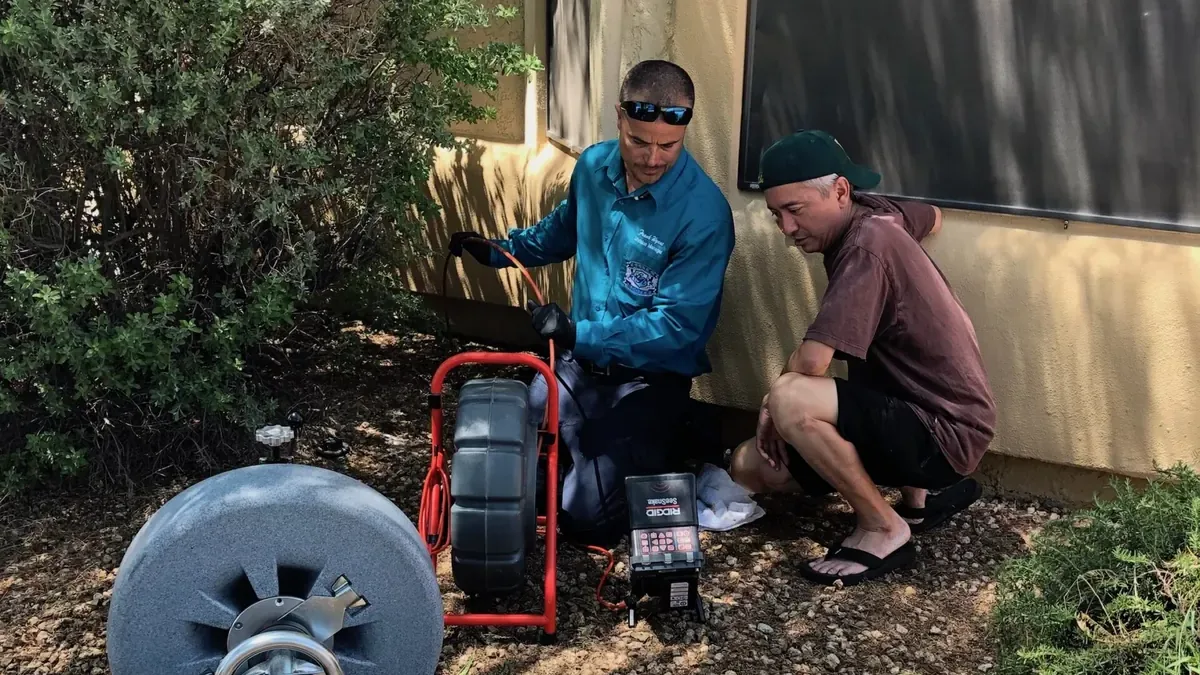
Symptoms alone cannot place the problem on one side of a boundary. Several backed-up drains may justify checking the sewer line, but they do not prove a broken lateral or a public-main problem. Elite Rooter's San Diego main-line service page explains how the findings guide clearing and repair decisions.
Read moreRead less about Get the pipe location and proposed work in writing
When an inspection is needed, ask for:
- The portion of pipe inspected, the access point used, and any section the camera could not reach.
- The observed obstruction or defect and how its location relates to the property line and public main.
- A copy of the available footage or report, plus the reason the proposed work addresses the finding.
Confirm which records are included before booking a camera inspection. A camera looks inside a line it can reach. It does not clear a clog. Cleaning may be needed before an inspection can show the pipe's condition.
Keep clearing, inspection, and repair as separate items in the written estimate. Ask who will deal with the sewer provider, pull permits, dig, and restore any paving or landscaping. A quote for pipe repair should explain where the work begins and ends.
The City's permit bulletin for sewer lateral work says a Right-of-Way Permit is required for work in the public right-of-way or in a water or sewer easement. Have the contractor confirm which permits and inspections the repair needs before digging begins.
If sewage is backing up now, stop adding water
Stop flushing and running water while the backup is assessed. Keep people and pets away from wastewater, and leave cleanouts closed for the plumber. Do not open one to see whether it relieves the backup.
A backup inside the home starts with a plumber. If sewage reaches the street or another public area, or you smell sewer odor outside, call the City at 619-515-3525, the number on its sewer spill page. If another agency serves the address, use that provider's emergency instructions.
If you rent, tell your landlord or property manager right away. The lateral is the owner's responsibility. If the toilet is the first thing to back up, our guide to what to check when a plunger is not working covers the first steps.
For help with private drains or the lateral, call Elite Rooter's San Diego team at (619) 478-4299.
Frequently asked questions
Does the City of San Diego pay for sewer lateral repairs?
Not usually. The property owner maintains the lateral all the way to the public main and repairs breaks between the house and the property line. The City may act on a blockage or break in its right-of-way when the home has lost all sewer service and a licensed plumber has filed a report. It does not reimburse private plumbing expenses.
Who do I call first for a sewer backup in San Diego, the City or a plumber?
Start with a plumber when the backup is inside your home. Call the City at 619-515-3525 if sewage reaches the street or another public area, or if you smell sewer odor outside. A plumber who finds a break or collapse beyond the property line files a Plumber's Report with the City at the same number.
I rent in San Diego. Who handles a sewer line problem?
Tell your landlord or property manager right away. The sewer lateral is the property owner's responsibility, including the part that runs under the street to the public main for City of San Diego customers.
Sources and methodology
- City of San Diego: sewer plumbing system
- City of San Diego: sewer lateral fact sheet
- City of San Diego: street and alley lateral policy
- City of San Diego: easement lateral policy
- City of San Diego: encroachment lateral policy
- San Diego County Sanitation District: boundary map
- San Diego County: district sewer lateral information
- City of San Diego: water, sewer or fire service permit bulletin
- City of San Diego: sewer spill reduction